

How the Olfactory Pathway Influences Sleep
To understand how scent can impact the way you sleep, it helps to look at how the brain processes it in the first place.
Unlike vision or hearing, which first route through a sensory relay station called the thalamus, smell follows a more direct path.
The thalamus filters and organizes most sensory input before it reaches higher brain regions.
Smell bypasses this step and travels straight from the nose into the olfactory bulb and then to the piriform cortex, which identifies odors, and the limbic system, which is involved in emotion, memory, and automatic body responses.
The limbic system includes structures like the amygdala and hippocampus, so scent signals reach areas responsible for emotional processing and memory very quickly, without a lot of filtering.
Through this pathway, scent has direct access to brain regions involved in emotion and stress regulation.
Does Sleep Stage Change Our Response to Smell?
Sleep isn’t one single state; it cycles through lighter and deeper stages broadly categorized into REM (rapid eye movement) and NREM (non-REM) sleep.
During NREM sleep, especially in the deepest slow-wave phase, the brain reduces how much sensory information it processes. Brain activity becomes slower and more rhythmic, which makes it harder for external signals to be picked up and processed.
In REM sleep, brain activity becomes more similar to an awake state, and this is the stage most closely linked to dreaming and emotional processing.
Because the limbic system is highly active during REM, the brain is especially sensitive to emotional signals, even without conscious awareness – and this ties back to scent.
In a controlled REM sleep study, participants were exposed to either a pleasant rose-like scent or an unpleasant odor while they were asleep. The scents were delivered in short pulses during REM sleep without waking the participants.
When they were later asked to report their dreams, those exposed to the pleasant scent described more positive emotional experiences, while those exposed to the unpleasant odor reported more negative emotional tone.
This suggests that the sleeping brain is still processing scent, even if it doesn’t fully wake you.
How Scent Can Be Used to Improve Sleep Stability
If smell can reach the brain during sleep and influence systems like stress response, breathing, and emotional regulation, the next question is simple. Can we use that intentionally to improve sleep?
Research suggests we can.
In studies involving fear conditioning and trauma-related symptoms, presenting odor cues during sleep has been shown to influence how emotional memories are processed, in some cases reducing fear-related responses the following day.
This matters because many sleep disruptions are not caused by external noise or light, but by internal signals. Elevated heart rate, irregular breathing, or emotional stress can all push the brain out of deeper sleep stages and back into lighter, less restorative ones.
Scent provides a way to influence those internal signals without forcing a state change.
Instead of waking the brain or overriding it, scent can support the conditions needed for stable sleep by:
-
reducing physiological arousal
-
slowing breathing patterns
-
reinforcing deeper sleep stages
-
modulating emotional responses
Applying the Science of Smell to Real Sleep with Kimba
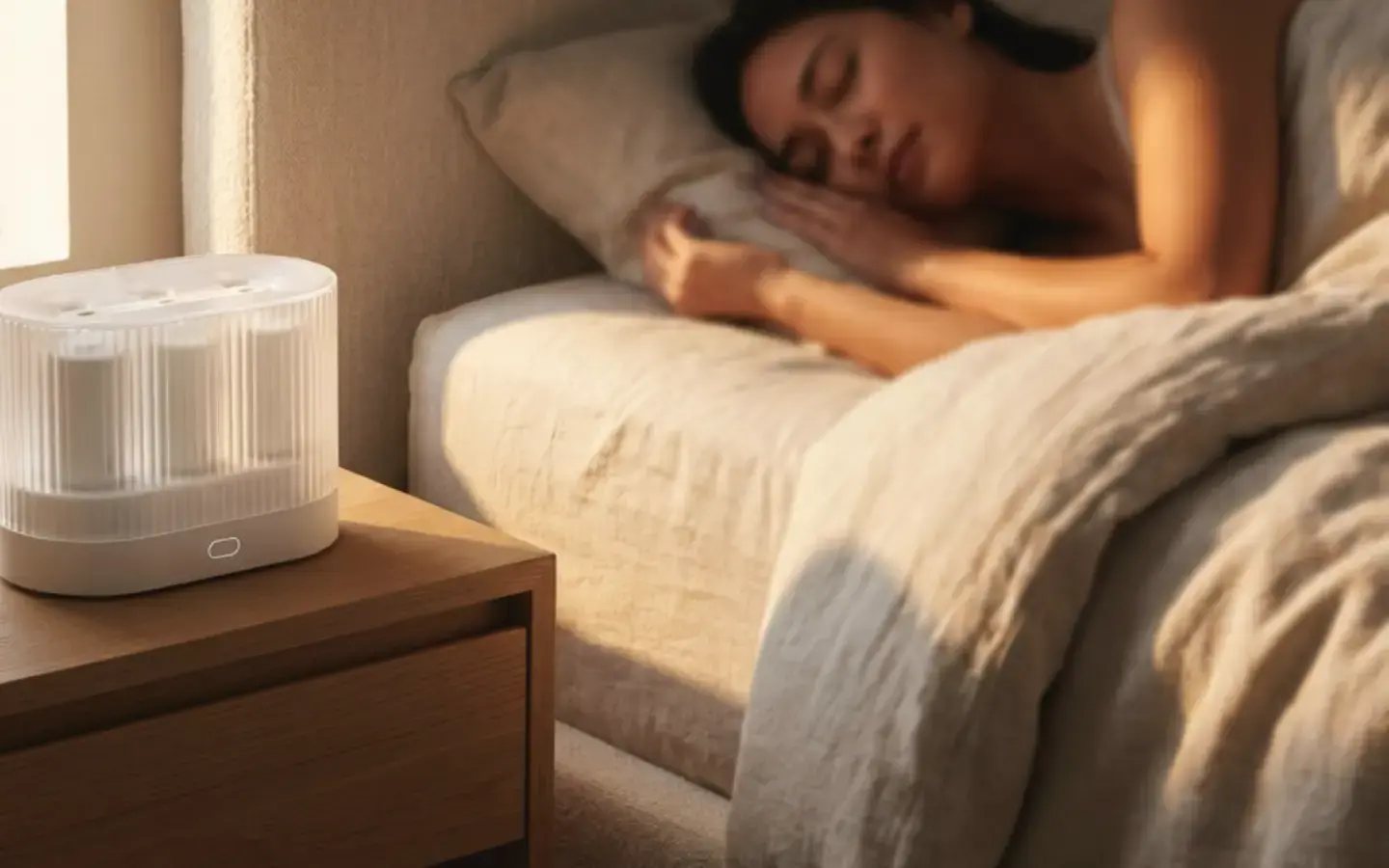
Everything we've covered so far points to one thing: scent can influence sleep when it's used at the right time and in the right way.
Kimba uses this to improve sleep by delivering scent at the right moments during the night.
Using its own built-in sensors, or synced with a wearable like a smartwatch or fitness ring for added precision, Kimba monitors your physiological signals during the night, including heart rate, breathing patterns, movement, and sleep-stage estimates.
With built-in AI, it detects when your body might be heading toward restlessness or an awakening. At just the right moment, it releases a short pulse of a calming natural scent.
For instance, if your heart rate is climbing and you're shifting in light sleep, Kimba might release a calming scent blend designed to nudge your brain back toward deep sleep.
Kimba's scent pulses are brief and precisely timed. This prevents your nose from "tuning out" a smell that's constantly present and ensures the scent remains effective when delivered.
Because our sense of smell doesn't usually wake us up, Kimba can work in the background without disturbing your sleep. It's a non-intrusive, natural form of sleep support, rooted in the idea of gently coaching your brain and body to relax.
FAQ
Does this mean I could just wear my own perfume or essential oil to bed instead?
Wearing a scent or leaving a diffuser running exposes you to it continuously, whether or not your body actually needs support at that moment. What the research points to is a moment-specific effect: a scent cue introduced right as physiological arousal is rising appears to matter more than the scent being present in general.Will I build up a tolerance to the same scent over time?
Does a stuffy nose or reduced sense of smell affect this?
Since the entire pathway depends on the olfactory system, anything that significantly blocks nasal airflow, like a cold or congestion, would be expected to reduce how much scent signal reaches the brain.
Can scent change what I dream about, or just how I feel emotionally?
The research so far points more toward emotional tone than dream content. Studies have shown scent shifting whether a dream is remembered as more positive or negative, rather than shaping specific dream narratives or storylines.
How fast does scent actually reach the brain once released?
Olfactory signals travel a very short, direct path to the brain, so the response is fast relative to other senses.


